The Dead Are More Visible by Steven Heighton
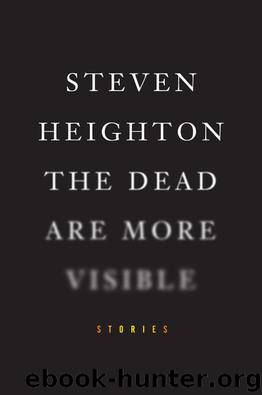
Author:Steven Heighton
Language: eng
Format: mobi, epub
Tags: Literary, General, Short Stories (Single Author), Fiction
ISBN: 9780307366689
Publisher: Knopf Canada
Published: 2012-01-01T05:00:00+00:00
[ FIREMAN’S CARRY ]
In memory of John Chappelle, 1954–2007
We shoulder the coffin of my friend Warren Reed down the front steps of the church and on toward the hearse’s gaping back door. It reminds me of the receiving mouth of a crematorium, that door—how a coffin will glide through and into the discreetly quiet, white-hot furnace beyond. I always wonder how they manage to keep such a ravenous blaze so quiet.
I’ve read somewhere that fire, to certain ancient peoples, was an animal, as alive and on the same level as humans, horses, birds, fish, insects, everything. It’s easy—especially for someone who has fought fires, and walked inside them—to imagine how the belief arose. Fire breathes air, like us. Fire eats wood as well as the flesh of animals, the dead as well as the living. It moves on its own, it has a voice and a vocabulary, it can seed itself and propagate, it can hibernate deep in the roots of trees and fully revive, it leaves a sort of bodily waste behind, it attacks, it withdraws, it can be tamed and domesticated, and finally, when it has eaten everything, it starves or else smothers or perishes by drowning. I’ve read, too, about a certain desert tribe who believed that while animals understood the language of fire, humans had somehow lost it, along with the other animal tongues—but that each person at the moment of death regained the capacity to understand. This tribe believed their dead should never be buried but instead burned, so the living flames could guide and sing the dead into the afterlife.
There will be no flames today, though—no furnace door. Firefighters seldom incline to the crematory option. Once we load my friend into the hearse, we’ll be getting into our cars and merging into the motorcade heading out to the cemetery on the outskirts of town, or what used to be the outskirts. Green and peaceful, breezy grounds, tall, stately hardwoods two centuries old.
My friend’s maple coffin is—do I need to say this?—heavy on our shoulders, though it’s not the burden it might be for an average pallbearer. There are six of us, and the five who wear full dress uniform (I’m the odd one out, in my formal civvies) are all in good shape, the way I used to be when I was signing in to the fire hall gym four times a week and carrying serious poundage into and out of burning buildings.
Then there’s the fact that we’re getting used to bearing these coffins and sliding them into hearses. It’s not what you might think, either—not fatalities on the job, floors and burning walls collapsing, chemical explosions. An occupational epidemic of cancer is what it is, cancer of the brain, cancer of the liver, plenty of lung cancer, pancreatic cancer, cancer from all the burning crud we’re inhaling in all the factories, garages, condos and offices we try to save. Still, my friend feels heavy in his coffin, this virtually bombproof carapace whose protection he could have used in life, on the job, but now has zero use for.
Download
This site does not store any files on its server. We only index and link to content provided by other sites. Please contact the content providers to delete copyright contents if any and email us, we'll remove relevant links or contents immediately.
The Tidewater Tales by John Barth(12639)
Kathy Andrews Collection by Kathy Andrews(11795)
Tell Tale: Stories by Jeffrey Archer(9012)
This Is How You Lose Her by Junot Diaz(6857)
The Mistress Wife by Lynne Graham(6469)
The Last Wish (The Witcher Book 1) by Andrzej Sapkowski(5443)
Dancing After Hours by Andre Dubus(5269)
The Sympathizer by Viet Thanh Nguyen(4371)
Be in a Treehouse by Pete Nelson(4018)
The Secret Wife by Lynne Graham(3901)
Maps In A Mirror by Orson Scott Card(3877)
Tangled by Emma Chase(3740)
Ficciones by Jorge Luis Borges(3615)
The House on Mango Street by Sandra Cisneros(3453)
A Knight of the Seven Kingdoms by George R R Martin(3302)
Girls Who Bite by Delilah Devlin(3242)
You Lost Him at Hello by Jess McCann(3057)
MatchUp by Lee Child(2869)
Once Upon a Wedding by Kait Nolan(2779)
